Thursday, April 7, 2011

Sea of Change

This is perhaps the best example of the Iceberg theory we have read so far. The reader has barely any information to make a claim about the characters in this story. Here is what I think.

I think the girl cheated on the man with another girl. I think she is bisexual and is experimenting with her identity. The man is obviously upset and states, "I'll kill her." He is confused by her action and asks, "Couldn't you have gotten into something else?" She responds with, "Seems not." I think she is struggling with the fact that he is upset. She doesn't want to hurt his feelings by being attracted to girls.

Event though she cheated on him she still states that she loves him. That is confusing for him and he doesn't believe her. He asks her to prove it. My guess it that he wants her to prove it by not being with a girl. She gets a little upset when he asks her to prove and says, "You didn't use to be that way. You never asked me to prove anything. That isn't polite." This statement leads me to conclude that they have been in a relation ship for a long time.

The couple that comes into the bar is two men. They converse with the bartender. I think it is interesting that it most of Hemingway's stories there are couples. Usually a man and a girl, and they are usually alone or only accompanied by wait staff. I wonder why this is.

At the end of the story the man decides to let the girl go. I think they both believe that she will decide she isn't a lesbian and that she will return to him.

He is taking a chance by letting her go and "he was not the same-looking man as he had been before he had told her to go." There was a change in his character that was noticeable to him and her. I don't know why he is trying to tell the barman that he is "quite a different man." Maybe he feels he has to prove himself to someone.

I liked this story and am very interested to hear the discussion we have today in class.

Cat in the Rain

I think I am completely missing the meaning behind this story. I think the best way to figure out what I'm missing to first state what I know.

-There are two Americans, George and the Americ-an wife or girl (she is referred to as both)
-They are staying in a hotel in Italy
-It is raining
-There is a cat outside the window that is sitting under a table trying to not get wet. The wife is looking at the cat and decides that she wants it. She decides to go downstairs to get the cat and the American (her husband) says, "Don't get wet."
-The wife likes the hotel keeper. "She liked the deadly serious way he received any complaints. She liked his dignity. She liked the way he wanted to serve her. She like the way he felt about being a hotel-keeper. She liked hid old, heavy face and big hands."
-She is about to head outside when a maid comes to her with an umbrella in her hand. The maid was sent by the hotel keeper.
- The Maid says, "You must not get wet."
-When the American girl gets outside the Cat is gone and "she was suddenly disappointed.
-She re-enters the hotel and the hotel keeper bows at her. "Something felt very small and tight inside the girl. The padrone made her feel very small and at the same time really important. She had a momentary feeling of being of supreme importance." ???
-"It isn't any fun to be a poor kitty out in the rain."
-She looks at herself in the mirror starts talking about how she wants her hair to be longer. "I get so tired of looking like a boy." Why does she suddenly feel less feminine?
-Then she lists things that she wants. "I want to eat at a table with my own silver and I want candles. And I want it to be spring and I want to brush my hair out in front of a mirror and I want a kitty and I want some new clothes."
-Her husband tells her to shut up and find something to read
-She then states, "I want a cat. I want a cat now. If I can't have long hair or any fun, I can have a cat."
-Then the maid knocks on the door with the cat in her hands and says, "The padrone asked me to bring this for the Signora."

Do the padrone and the American have some sort of connection? Why is he so protective of her wishes and feelings?

Lastly, and perhaps most importantly, why does she want a cat??? Dogs are fit to be much better companions. But I suppose that is a topic for another blog.

Poetry Symposium

I really enjoyed listening to the poets speak at the Poetry Symposium: Living by Poetry.
What I found most interesting about the symposium was when the poets talked about important poetry is to them.

Art said that he tried to not write any poetry for a year or so. He said that it almost destroyed him. To me it seems incredible that the simple act of poetry (or lack thereof) can have that much effect on someone. He was literally in pain and didn't feel like himself because he was not writing. I think for Art, poetry is his release from life. He can focus his emotions on something other people. I think he uses poetry as an outlet to express his feelings and thoughts. I believe that everyone needs some outlet for expression. It is not healthy to go through life with a jumbled mess of emotions hidden deep down inside. Life if full of unexpected twists and turns and I think a part of dealing with those events is to express in some way how you feel about them.

After some reflection I realized that there are many things in my life I could not go a year without doing. The first one that comes to mind is playing the piano. At home I play the piano almost everyday. Sometimes I practice for a few hours and sometimes I just play. Practice and play are very different and serve different purposes. However, I enjoy both and would miss both if my piano was somehow taken away. Like poetry is for Art, the piano is my outlet of expression. I choose the songs I play based on my feelings, the weather, what time of day it is, where I am, and who is listening. I can play softly when I'm sad and loud when I'm angry. The piano is a blank canvas on which I can create any sort of picture that I want. Without that I think I would feel lost and maybe a part of me would be destroyed, much like Art when he stopped writing poetry.

Another interesting part of Art's story was that he said poetry found him. He was 17 years old when he wrote his first poem and besides that one year period, he has been writing poetry ever since. I am interested to know what called upon him to write that first poem. What was it about? Was it something he would publish today? One thing about life that is very interesting to me is the concept of firsts. What was your first poem, the first song you played on the piano, the first school you ever went to, your first kiss, your first solo drive. The first time we ever do something can be terrifying, or exhilarating but all first time experiences have some sort of meaning.


Monday, March 28, 2011

What is Art?

After our discussion in class on Thursday I decided to think more about what is art. I googled "what is art?" and the first article that came up said that all art consists of two things: form and content. The author of the article stated that form includes:

1- the elements of art

2- the principles of design

3- the actual, physical materials that the artists has used

We discussed Robert Mapplethorpe's and Andres Serrano's photographs and I think everyone decided for themselves if they believe it to be art or not. Some people thought that the photos crossed "the line." What IS the line? How can anyone define what is art and what is not?

I think that all art has an intention and a purpose. It is something created thats sparks feeling or emotion in someone else. Those feelings can be positive or negative. I have seen a lot of art that I do not necessarily like or agree with. When I visited the Seattle Asian Art Museum during Spring Break there was a painting of a chicken struggling to fly in a city-like landscape. The painting was about the struggle of nature verses man made structures. The chicken's flight path was expressed like a flip book laid out on a table rather than bound together. You could see each step of the flight and it was obvious that the chicken was having a difficult time. I looked at the painting and immediately felt uneasy. In my mind that chicken should not be trying to fly around in a city. Indeed, that feeling of uneasiness was the emotion the painter intended. After reading the description I found that the intention of the painting was to express how difficult it is for nature and man to coexist.

I did not like this painting whatsoever. I would never put it on my wall or carry a picture of it in my wallet. However, it is still art. Sometimes I think people deem things as not art or as crossing the line simply because they do not like it or approve of its message. Such is true for the Mapplethorpe and Serrano paintings. I may not agree with all of the messages they are trying to express but I do recognize their work as art because it has a purpose and an intention.

A chair is a chair, and a urinal is a urinal but if they are presented as art, then there has to be some kind of intention behind that. What makes Marcel Duchamp's piece "the fountain" a piece of art is the name. I think that he was trying to get observers to look at a urinal in a different way. He didn't entitle the piece, "urinal" for a reason. Because he intended for the sculpture to be viewed as a different object with a difference purpose that makes it art, at least to me.


Saturday, March 5, 2011

Vogue circa 1923

After asking the assistant at the library desk where I could find the periodicals I went searching. The vastness of libraries have always intimidated me. It seems as though I'll never find what I'm looking for. Thank goodness for librarians and there knack for organization. I found the bound periodicals down in the quiet basement. Since I am getting a degree in Fashion Merchandising I figured exploring the pages of Vogue would be the most interesting to me. I found the Jan-Jun 1923 book of Vogues. The book was so heavy and awkwardly large but I'm glad I took the effort to get it off the shelf.
Since my birthday is February 3rd I looked at the February 1st issue. When vogue first began publication it was published on the 1st and 15th of each month. What struck me first and foremost about the issue was the language used in the advertising. The new spring fashions were "flatteringly lovely," and one particular sportswear design was the "smartest sport silhouette" of the season. There were a lot of references to France and French words as well. This is due to the fact that in the 1920s France was looked upon (as still is ) as the fashion capital of the world. The publishers of Vogue looked to Europe for all of their inspiration and knowledge about fashion. Some of the phrases in the magazine including, "mode of the moment," and "the fickle beau monde," are obviously phrases centered around French words. The entire issue was filled with French influences.
The advertisements were selling goods that most people don't have the need for anymore. In the 1920s a majority of Americans were still making and constructing their own clothes. Therefore, a lot of the advertisements were for items such as bias tape, collars, safety pins, elastic and snap fasteners. An advertisement for these notions could now be found in specialty sewing and crafting magazines but certainly not in Vogue.
Another interesting thing about this Vogue was the lack of photographs. Illustrations were still being used the majority of the time during the 1920s. Instead of magazines having a signature photographer, they had signature illustrators. The illustrations were very detailed and offered the reader a good idea of what the fashions for spring would entail. All of the illustrations had descriptions next to them, describing color, fabric, and use of the garment. The illustrations and the photographs in the magazine were all in black and white.
One of the articles I read caught my attention because it was about a great change that had occured in society. I guess that this "great change" would have something to do with society or some of the aspects of the century that we have talked about in class. After reading the first paragraph I realized that my guess was far off. The article went as follows, "After the end of the New York season-a great change has taken place in society- a change that is very near a revolution. Entertaining is unquestionably more informal, and entertainment more amusing." Not really what I was expecting.
Overall I enjoyed flipping through the pages of fashion's most influential magazine. I am interested to see what Vogue looked like later in the century, during the 60s, 80s, and the year of my birth, 1991. I'll be looking through some of those books I'm sure in my years to come as a fashion merchandising major!

Museum of Modern Art


First of all I would just like to say that I love art and I love museums. Therefore art museums are one of my favorites things in the whole wide world. My family used to travel around a lot. One summer we spent 13 weeks in our R.V. traveling from Fort Worth to North Carolina and back. We have made a lot of trips in our R.V. spanning almost the entire country. The best way to describe my family's traveling style is basically "from museum to museum." I have seen museums about Native American cliff dwellers in Arizona, Old Plantations in Mississippi, President's homes in Virginia and Air and Space Museums in D.C. I'd say that if you love museums go to Washington D.C. because there is something for everyone there.
Out of all the museums I have been to I love the art museums the most and usually the modern art museums best of all. They usually have the most interesting architecture and the most thought provoking work. The Modern Art Museum here in Fort Worth is no different. Its one of my favorite buildings here and by far one of the most "modern" in this cow town.
The reason why I love modern art so much is because its purpose isn't obvious. You have to really sit and ponder each piece as you go. Why did the artist paint/sculpt/create this? What does it mean? What does it represent. Often times when confronted with modern art I am perplexed as to what I'm actually looking at. I think its always important to read the descriptions of each piece of art that the museum provides on the wall. It is very important in a museum of modern art. I remember looking at a painting that was a solid color with a ride line right through the middle. At first glance it didn't look like much. However, after reading the artist's description of his work I learned that the solid background represented the artists life, and the red line represented God and His influence on the artist's life. Now it makes sense.
I think some people approach modern art the wrong way. You can't walk into a modern art and expect to understand every piece. Some of the works are not meant to be understood. But I sincerely believe that every piece of art has intent. There is a purpose to its creation and there is a reason why its hanging on the wall. A lot of people become frustrated with modern art because they see the work and say, "I could do that." But the fact is, you aren't doing it. The artist felt compelled to create and that's what he or she did. Thats what separates us from the artists. They are actually doing it, they are really creating. As viewers we are just observing, and we have to remember to appreciate their efforts of creation.
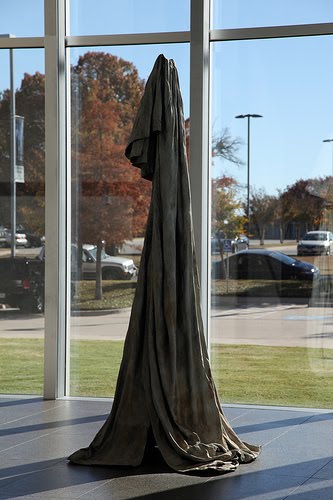
My favorite piece of art in the Fort Worth museum is the first one you see as you enter the building,"Drape" by Joseph Havel. There is something about this sculpture that I love. If I could I would put this piece in the entry way of my home (that is, when I have a home.. and not a dorm room). I would love to be able to look at it everyday, all day if I wished. I think the reason I like it so much is because it appears to be a drape made of cloth, simply suspended in the air. However when you get closer you see that it is made of metal. How did Havel manipulate the metal to make it look so pliable? The piece looks as though it could fall to the ground with the simple touch of a finger. Its strength is secret.

Nous avons parlé Français!

Nathan said that we could speak French at our second meeting and that we did! I brought my French notebook and two packets of selected reading materials from my French classes that I have taken at TCU. I greeted Nathan in French and we sat down to talk. We basically went through my notebook and talked about the notes that I had taken from class. My class last semester was about French culture which included, Religion, Work, Education, Immigration, Politics and Holidays. We went through each section in my notebook and discussed each topic (in French!). Since Nathan is from Belgium we talked a lot about the differences and similarities between France and Belgium.
We talked about Religion first, and mostly about the banning of the veil (la voile) in France. In France it is against the law to wear any religious symbol that "is a menace to the public order." Apparently wearing a symbol of one's faith is considering menacing to those that do not follow the same faith. "La voile" was banned in both France and Belgium. I asked Nathan if there were any problems with the new law at his school. He said that there were a few students at his school that had protested against the law and wore their veils to school anyway. The principal had to tell the students to remove their veils. I asked Nathan if the school really cared that much or if it was just a question of following the government's law. He said that his teachers didn't care and didn't ask the students to remove their veils unless prompted by a person of higher status. Then I asked him if students who wore a large cross or other Christian symbol were ever asked to take if off. He said yes. So I think that for the most part the government is trying to keep all religious symbols out of the open. Nathan asked me if we could wear whatever we wanted in America and I told him that people can wear any and all religious symbols.
After religious we discussed Education for a while. Nathan went to Catholic school up until middle school and then went to a public school for high school. He said that at his public school there was a mix of Catholics and Muslims. He said that there were a lot of fights at school over religion. Nathan came to the United States for college so he could learn English and also because school here is much easier than in Belgium.
Then we moved onto the topic of immigration. In France immigration is a huge problem. There are a lot of immigrants that live in "le banlieues" (ghettos) in France. Some are legal and some are not. However, even though their living conditions in France are not the best they are far superior to what they would be living in in their native country. France, however has begun to blame the immigrants for problems in the economy. There is very strong support behind a political group called "Le Front National" that is right-wing group of anti-immigrants. Le Front National wants to return France to the French, and to kick out all of those who can not trace their lineage back to France. I asked Nathan if Belgium had the same sentiments regarding immigration and he said that Belgium liked the immigrants. He said that the Belgian government tried to help immigrants whenever possible.
We ended out conversation talking about working and living in France. I told Nathan that I would really like to work with fashion in Paris someday. He said that Paris would be a wonderful place to visit but that he couldn't imagine living there. He said that it is extremely expensive and that Belgian is generally way better. He also said that the French aren't as nice as Belgians. Although the Belgians may be nicer and less expensive they can't offer me a Fashion Week so he hasn't persuaded me to abandon all of my Parisian dreams.
Throughout our conversation we were able to communicate with only a few misunderstandings. Sometimes I would conjugate my verbs in the wrong tense or use the wrong pronoun but he would correct me or help me continue forming my sentence. For me, speaking has always been difficult because I can't write everything down first so sometimes I forget what tense I'm in or which pronoun to use. But overall I think I did a good job! And Nathan complimented me on my accent so that made me feel good. I haven't forgotten much at all even though I'm not taking a French class this semester.